Woven in Our Community
Breakers: Sail Loft Scraps on a Museum Wall
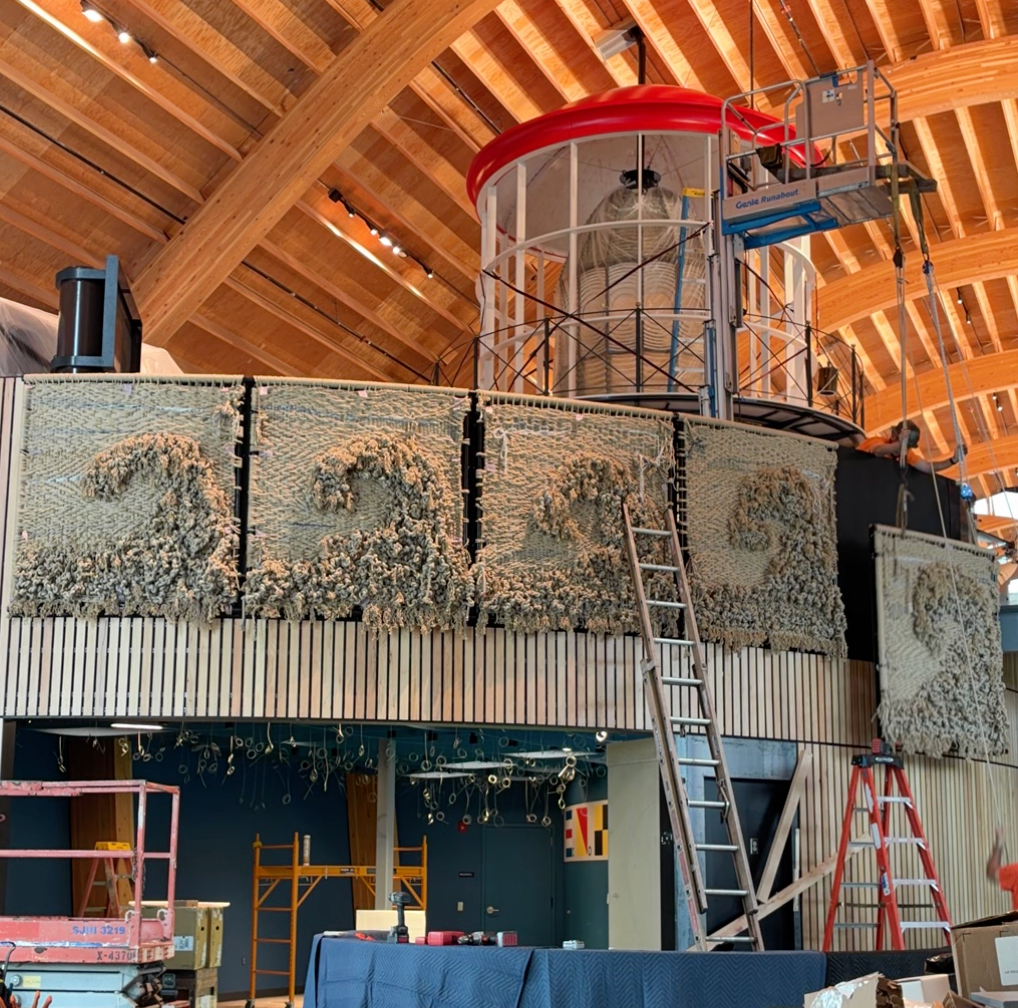
Where the Columbia River meets the Pacific, the river's current breaks into large standing waves that make the Columbia River Bar a serious hazard for boats. Those waves are now made of rope, hanging on a wall in the Columbia River Maritime Museum's new Mariners Hall in Astoria.
The piece is called Breakers, a 25-foot installation by Port Townsend fiber artist and former yacht rigger Margie McDonald. It hangs beside the Cape Mendocino lighthouse Fresnel lens, and it opens to the public in Mariners Hall on November 20, 2026.
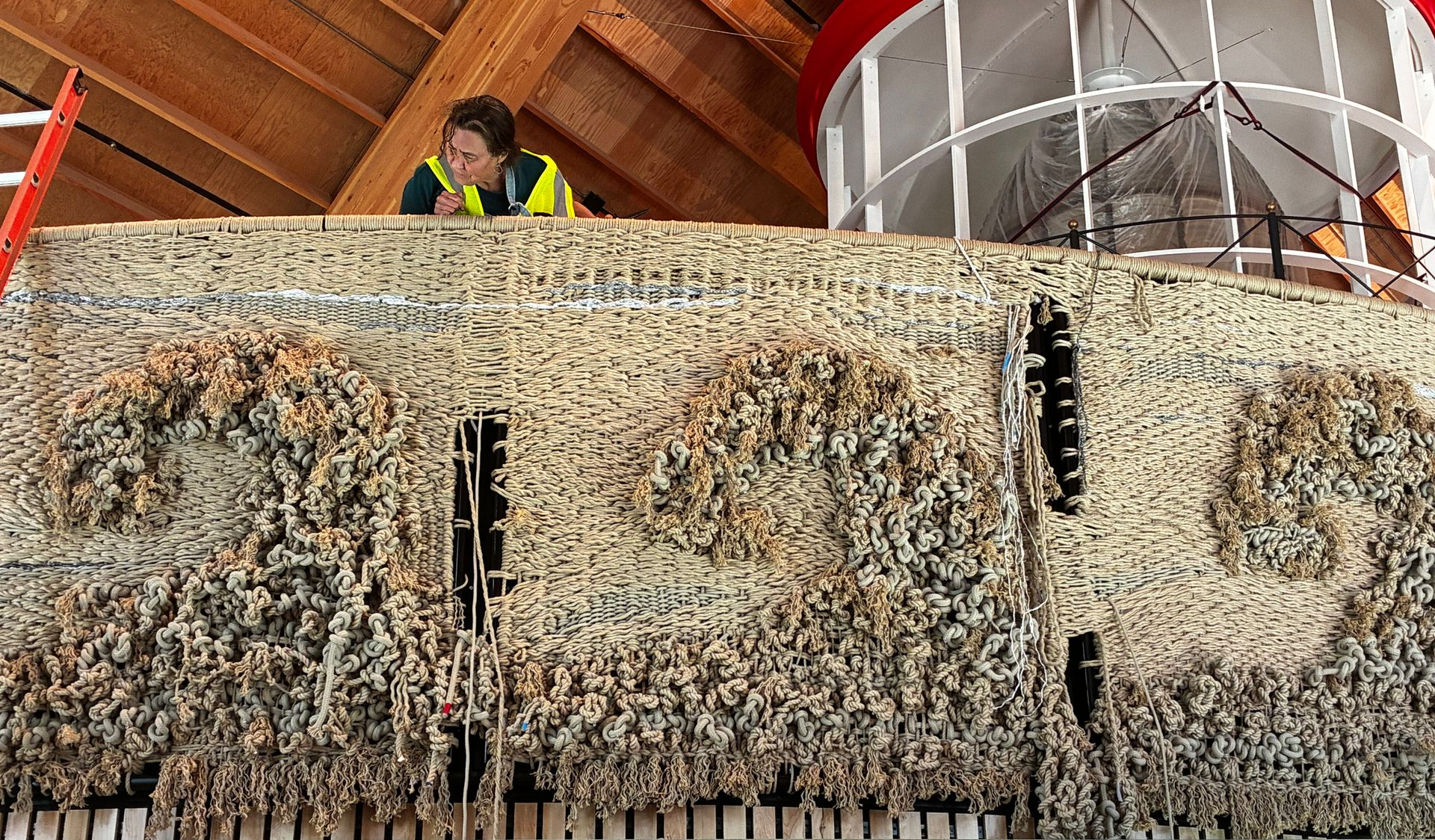
Look closely and you'll find silvery lines running through the background of the waves. That's Dyneema, high-strength line left over from splicing at Port Townsend Sails. The legendary sail loft, founded by Carol Hasse in 1978, is now a division of Port Townsend Shipwrights. Our sailmaker Alison Wood, Margie's close friend and fellow rigger, helped hang the piece and weave its panels together.
Like the rope in Breakers, the story behind it is woven from many strands: a rigging shop, a sail loft, a boatyard and a friendship, all tied together by Port Townsend's maritime community.


A wall too big
In the fall of 2024, the museum called Ian Weedman, who runs Brion Toss Yacht Riggers in Port Townsend, looking for an artist. Ian suggested Margie. It was the first time the museum had ever commissioned a work of art.
The first request was enormous: a proposal to cover a wall 16 feet tall and 96 feet long. Margie made many samples and went to Astoria to present her ideas in February 2025. A wall that size covered in rope didn't fit the budget. It would also be busy for a museum, "not to mention its attraction to young climbers," Margie says.
The museum and its architects still wanted a piece from her, so the plan shrank to 5 by 25 feet. Margie chose the Columbia River Bar as her subject. "The power of the waves is on full display at the museum and was a natural choice once we settled on the size and location of the commissioned piece," she says.
The piece being made in five panels has meaning too. "There are five major tributaries entering the Columbia in Oregon", Margie says, "so I asked for five panels."


Two miles of rope, thousands of knots
The museum picked its favorite of her samples, and Margie made a life-size test panel with a wave to work out how much line she'd need. The finished piece is five panels, each 5 by 5 feet and about 200 pounds, made from more than two miles of rope.
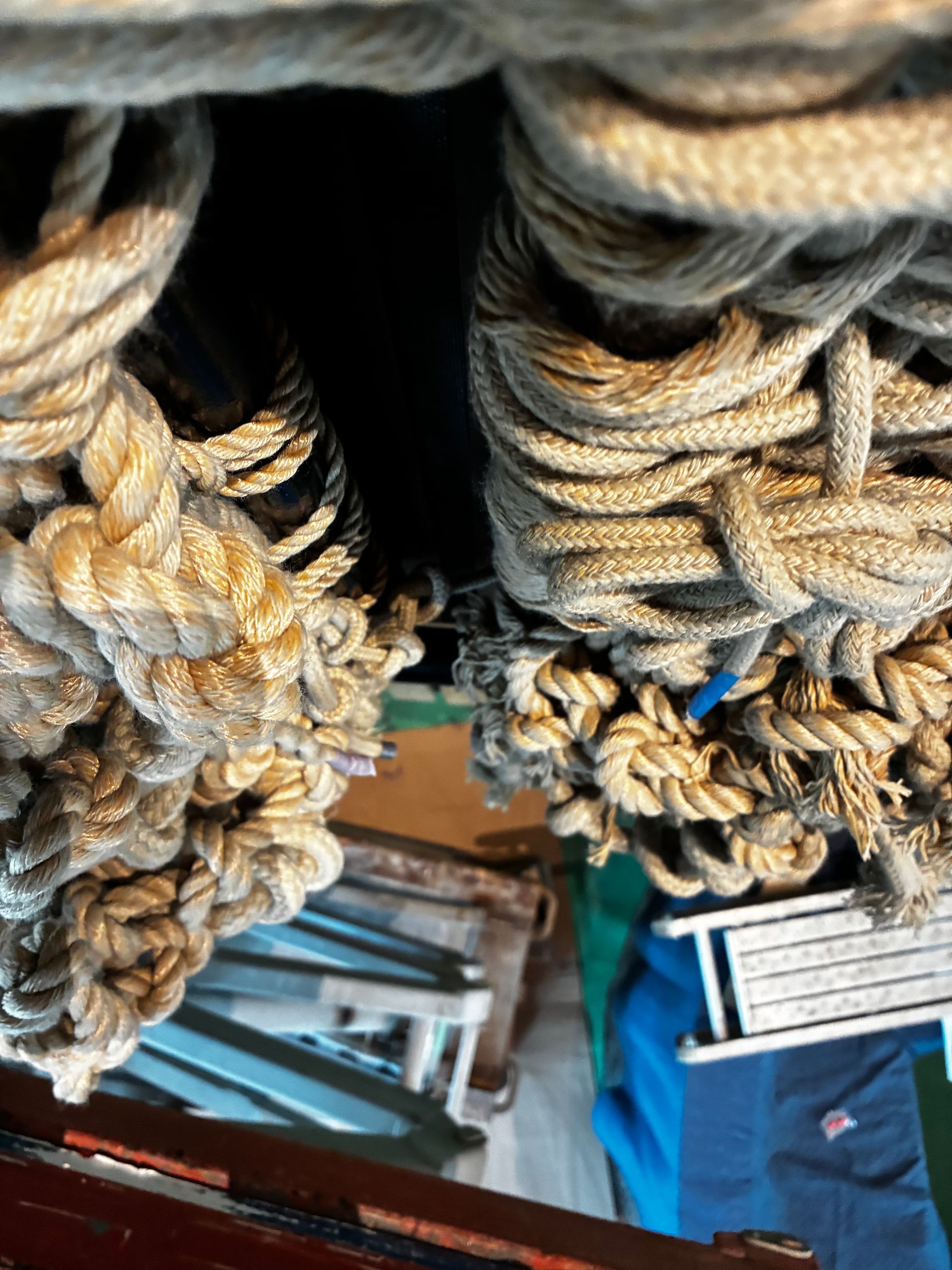
She wanted texture and depth. To build up the waves, she tied thousands of overhand knots until they stood 8 inches thick. To soften and flatten the background, she unlaid, or untwisted, a couple thousand feet of three-strand rope.
Most of the rope is new line from New England Ropes, in two kinds:
- Three-strand is a twisted rope. It can open up a little, which gives the soft texture across most of the panels.
- Double braid is a braided core inside a braided cover. It makes the tighter, smoother sections.
Margie admired the piece's sepia look, with all the line close to the same color. But it needed something more. "Everything needs sparkle," she says. Since the piece would be seen from below, she wanted the waves to drip water, so she sewed on hundreds of clear crystals that catch the light now and then.
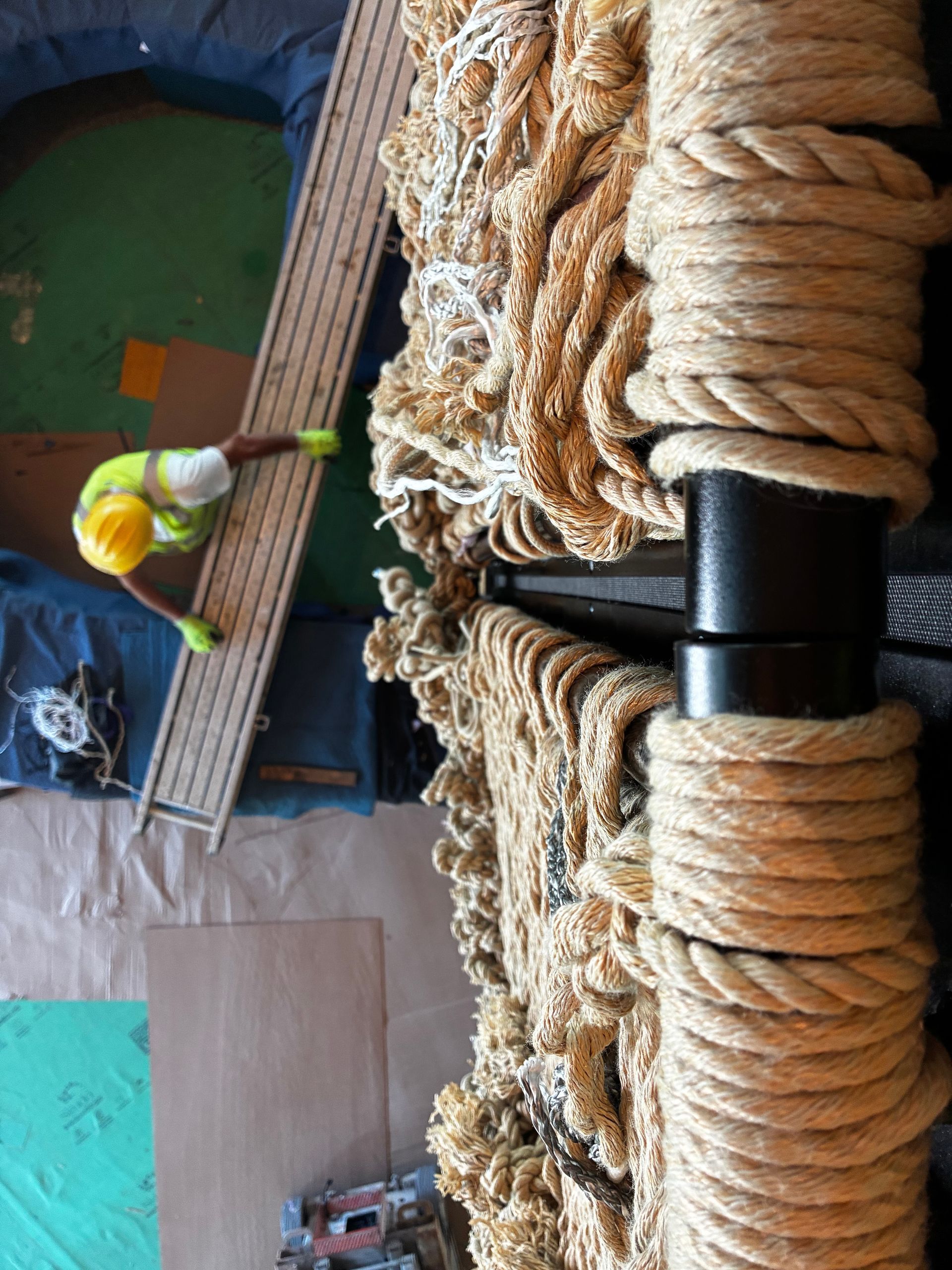
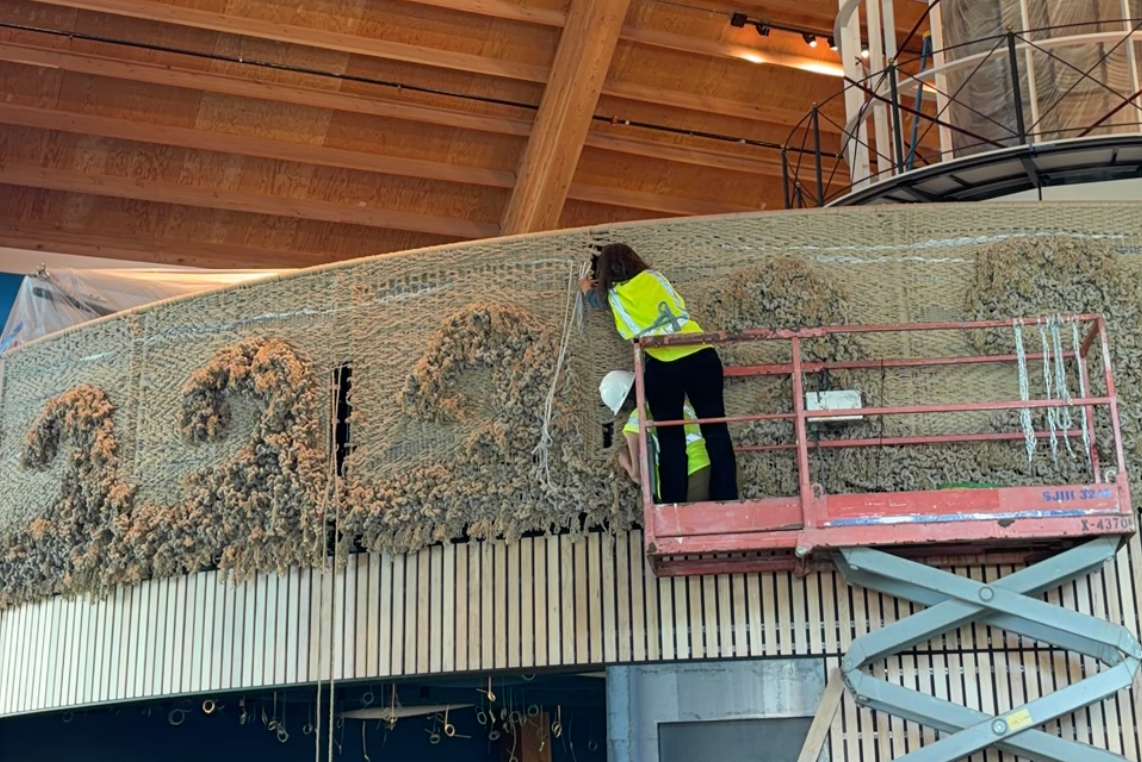
After the panels were hung, there were still gaps between them. Alison drove a lift, which stood in for scaffolding, while she and Margie worked their way down each 5-foot seam, weaving the panels together so the waves read as one piece, with Margie fine-tuning as they went. From first ideas to installation, Breakers took about 600 hours.
Mariners Hall was still a construction site, so Margie and Alison wore hard hats and safety vests during installation. They worked alongside welders, electricians and lighting crews. Some of them were riggers too. Plenty of trades need rigging know-how, from electricians to theater crews, and many of those riggers learned from Brion's books. One told Alison, "Oh yeah, I have Brion Toss books. I know that splice." When Alison introduced Margie as the illustrator of Brion's Working Rope books, the crew was amazed. "It's just fascinating to see, how many people know of Brion Toss," Alison says, "and what trade they come from".


"It's yours"
While Margie was at Brion Toss, a new kind of rope was arriving: high-modulus line such as Dyneema. It's very strong, but it's also slippery, and tying a knot can cut a line's strength by up to 70%. So it gets spliced instead, usually with a Brummel, where the line is tucked through itself and a long tail is buried inside, a bit like a Chinese finger trap.
The usual Brummel needs both ends of the line free. Margie remembers the day she was "messing around with this new line that apparently could be spliced only one end." She took a splice apart and put it back together using just one end. Brion watched and asked her to do it again, and again.
"I asked 'is this not how it's done?'" Margie says. "His answer was 'what do you want to call it? It's yours.'" Brion suggested the name, and the McDonald Brummel was born.
It's part of everyday work for our sailmakers. Every drifter we build gets high-modulus line in its luff, the sail's front edge. Once the tack is finished and the line is pulled through the sail, only one end is left, so we finish the head with a McDonald Brummel.
The splice turns up at the museum, too. Ian rigged the bridles that hang boats inside Mariners Hall, and he finished the second end of each one with a McDonald Brummel.

One long thread
Margie grew up in Newfoundland, knitting and weaving. She earned a BFA in Textile Arts from the Nova Scotia College of Art and Design, then taught art in Newfoundland for six years.
Looking for warmer adventures in the Caribbean, she ended up sailing across the Atlantic. That's where she met her husband, shipwright Alan Katz, 32 years ago, when the two of them had to share a bunk on a 42-foot boat. After years of sailing and commercial fishing, she landed in Port Townsend in 1998.
Here she apprenticed as a rigger under Brion Toss and went on to illustrate the Working Rope book series with him. Rigging taught her to splice 1x19 stainless steel wire, the stiff 19-strand cable that holds up a sailboat's mast. "Margie and I are probably only two of a handful of women in the world that know how to splice one by 19 wire," Alison says.
Alison and Margie met through Brion's shop, but Alison started out as a customer, hiring Brion Toss to work on her boat. Alison realized she loved the rigging work and was drawn to hire on. By the time Alison officially started at Brion Toss, Margie had moved on, but she and Alison were already good friends. When Alison stayed late to practice her wire splices, Margie would come by to keep her company and give her tips. "Brion taught and trained me, but Margie really cemented it," Alison says.

To Margie, rigging, fishing and art were never separate lives. "Splicing is weaving, mending nets is knotting, and making wearable art and sculpture is all of the fiber art skills often combined," she says. "Definitely one very long thread connects it all."
Margie has since built a career as an artist and educator. She has designed sets for Key City Public Theatre and builds sculptures from wire and salvaged objects. She is the longtime artistic director of the Port Townsend Wearable Art Show, and her own wearable pieces have been shown at the World of WearableArt in New Zealand. Her sculptures have been exhibited at the Bainbridge Island Museum of Art, Northwind Art in Port Townsend and the Museum of Northwest Art. Her first theater set was a large tree made of three-strand rope, which later grew into an even larger tree for a movie set in Los Angeles. Alison helped with that one too!
Saved at the 11th hour
Alison joined Port Townsend Sails in October 2008, when Carol Hasse's crew filled the sail loft at Point Hudson. "At that time there were about 14 of us on the floor," she says. "We were making around 10 sails a month!"
Carol announced her retirement in 2019 and planned to close the doors on her 70th birthday, in February 2021. The loft finished the work already on its books, and most of the crew started looking for other jobs. By the end, only five sailmakers were left.


Then, in December 2020, Port Townsend Shipwrights agreed to buy the loft. "It really was the 11th hour," Alison says. "we were caught completely by surprise, not expecting that at all. We love what we do, and were like wow, we get to keep making sails!"
The Shipwrights officially took over on March 1, 2021, and that October the sail loft moved from Point Hudson into the Port Townsend Shipwrights yard, our boatyard at the Port Townsend Boat Haven marina. The wait gave the Shipwrights time to build a new sail loft inside their buildings, so sailmakers and shipwrights could all work side by side. Alison and three of her fellow sailmakers came along. Carol also stayed on for a while to help with the transition, getting sail orders back on the board.
The sailmakers brought everything with them from Point Hudson, and the Shipwrights built them a loft that feels a lot like home. Customers who knew the old loft are often surprised when they walk in: it feels just the same as before. Take a look at these photos of the old Point Hudson loft, then come by and see how much of that feeling made the move.


Come see our sail loft. Port Townsend Sails still specializes in sail repairs, upgrades, and building sails with the same quality and craftsmanship as they always have. If you're planning a refit or a voyage of your own, stop by and visit our sail loft during drop-in hours (Tuesday through Thursday, 9 a.m. to 4 p.m.) or contact us to make an appointment. We'd love to see you!
Our scraps in the waves
When we finish splicing in the loft, there's always a short tail of line left over. For years Alison has saved those Dyneema remnants in a bag so people could practice their Brummels. For Breakers, the bag went to Margie.
It's far from the first time scraps from our sailmakers have shown up in Margie's work. "We collect our scraps and bits, and she uses them in a lot of her art," Alison says.
Those remnants, along with more from Ian, are the same high-modulus line the McDonald Brummel was created for. Margie wove lines of it into the background of the waves, where its silvery grey "adds a certain depth," she says. She even made her signature on the piece from the same kind of line, finished with four Brummels.
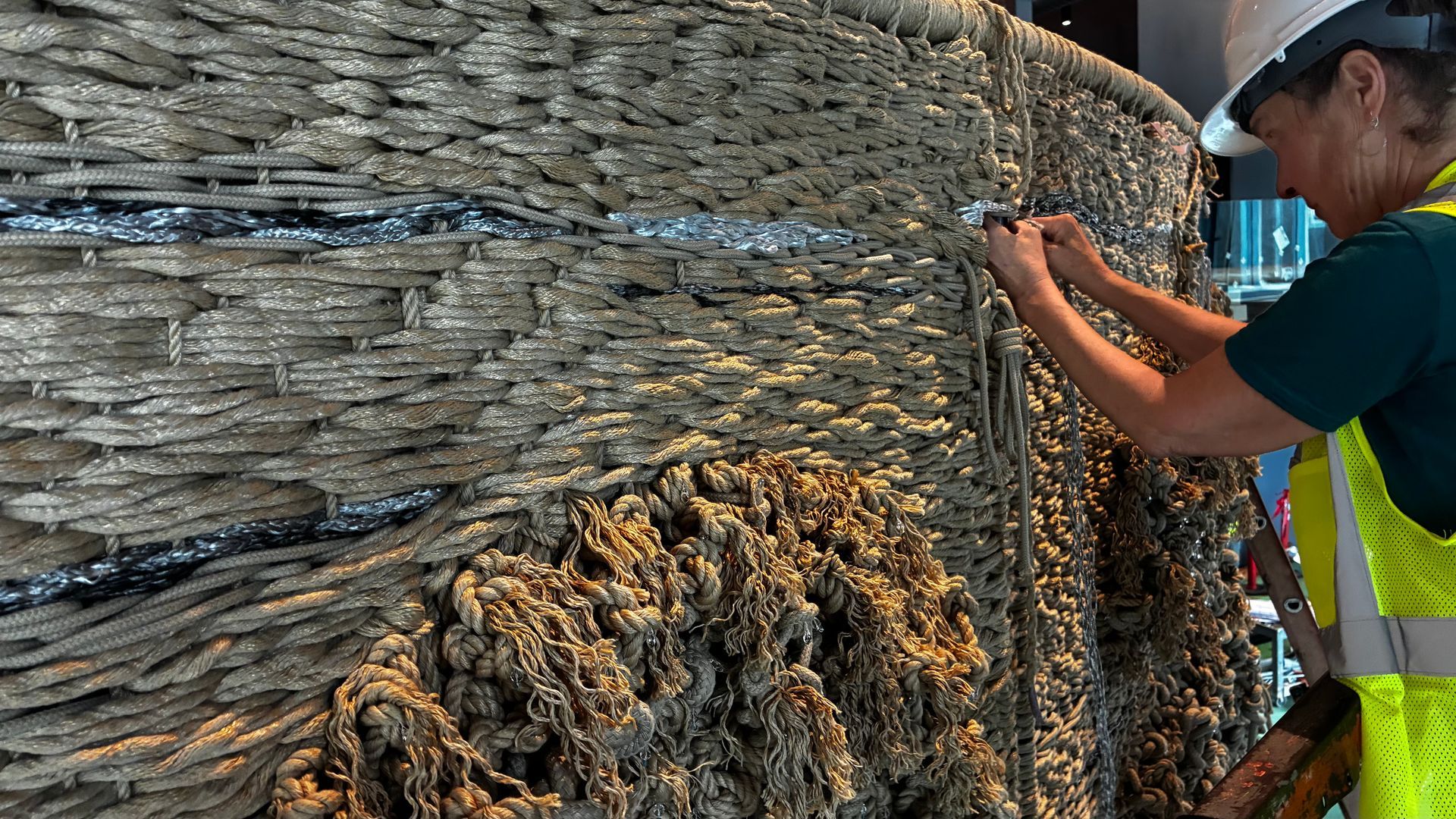

From the floor, you'll catch hints of silver and gray in the waves. "You'll certainly be able to see those spots that came from the sail loft, those little remnant pieces," Alison says.
Alison's favorite look at Breakers so far came at the end of a workday. Walking the trail outside after the building had closed, she could see it through the windows, lit up above the welcome desk, right at the entrance. "It's just so stunning," she says. She's looking forward to seeing it once the welders and electricians are gone, as "that more organic rope piece" among the lens and the historic boats.
"A process of discovery"
Most of Margie's sculptures start without a plan. She mostly works with wire and objects headed for recycling: metal, plastic, wood, beads, fasteners, sailcloth scraps and lots of little objects. "I start playing with wire and bits of scrap and see what happens," she says. "It's a process of discovery." The results often look like creatures from the deep sea, nature inspires her.
What catches Margie's eye? "Sometimes like a crow, shiny is attractive," she says, "the stranger the better." She looks for unusual shapes, interesting color, and small objects with a hole or two that can be tied together into something larger. "My hands do the work while my mind follows a recorded library book," she says. Not thinking about the sculpture is part of how it surprises her.
Port Townsend's boatyard is one of her best sources. A dumpster at Integrated Marine once gave her a load of twisted stainless steel strips she's still working with. She has used old rigging wire and trolling wire for years, and her husband, Alan, brings home scrap wood and other finds saved from the trash. Her studio, a 40-foot trailer from the 1950s, is "chock full of inspirational material," she says. "I just need to step inside and pick something up and play."
The sail loft has been passing along sailcloth scraps and "all kinds of interesting bits" for years, Margie says, and much of that sailcloth has become wearable art with the students she teaches.
Asked what she'd change in the world if she could, Margie says, "Keep art in schools... art teaches one to think and to creatively solve problems." And for everything else? "Let's make more art from discarded materials."
The habit goes back to Newfoundland. "Growing up without money means waste was not an option," she says. As an artist-in-residence at the local transfer station, where the county's trash and recycling are dropped off, she saw how much of what we throw away is still usable. "The wealthier the town the better the cast offs," she says.
People react to the work in all sorts of ways. Some appreciate the reuse, or the hours that went into a piece. Sometimes they tell her what a material really was, which is how she learned she'd once used a hip replacement joint in a small sculpture. And now and then, she says, she hears "you call that art?"
What's next
The Mariners Hall grand opening is Friday, November 20, 2026, at 1:00 PM at the Columbia River Maritime Museum in Astoria, Oregon. Details at crmm.org.
Breakers hangs above the welcome desk in Mariners Hall. Alongside Margie's piece, visitors will find a suspended HH-52 Seaguard helicopter, the Cape Mendocino lighthouse Fresnel lens, the USCG Triumph II set up as a Columbia River Bar deck experience, 19 vessels, and a hands-on STEAM space and classroom, the Daily Astorian reports.
Next for Margie is a show where much more sailcloth from PT Sails will appear, at the Bainbridge Island Museum of Art in October 2027.
Follow the threads in Breakers and they run all over the waterfront. Brion Toss trained both Margie and Alison, and his books reach riggers in trades far from boats. Margie's splice finishes every drifter our sailmakers build, and the bridles that hang boats in Mariners Hall. Port Townsend Shipwrights kept Carol Hasse's sail loft working when it could have closed for good. And a bag of scraps from that loft now runs through a wave in Astoria.
If you make the trip to Astoria, look up for the silver lines in the waves. That's a little bit of our sail loft.
Shipwrights News & Stories